Autumn 2026
Arabic
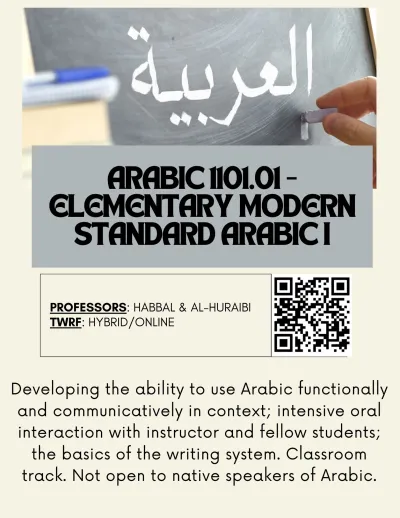
Arabic 1101.01 - Elementary Modern Standard Arabic I
Developing the ability to use Arabic functionally and communicatively in context; intensive oral interaction with instructor and fellow students; the basics of the writing system. Classroom track. Not open to native speakers of Arabic.
Prereq: Not open to native speakers of Arabic. Not open to students with 1101.02 or 4 cr hrs of 1101.51. This course is available for EM credit.
Professors: Manal Habbal, Nahla Al-Huraibi
GE Foundation: World Languages
Credit Hours: 4
TWRF: Online & Hybrid options
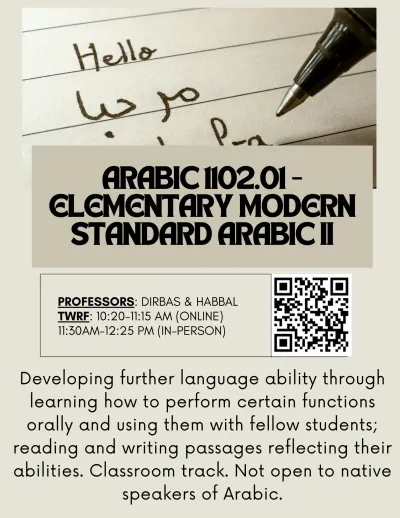
Arabic 1102.01 - Elementary Modern Standard Arabic II
Developing further language ability through learning how to perform certain functions orally and using them with fellow students; reading and writing passages reflecting their abilities. Classroom track.
Prereq: Not open to native speakers of Arabic. 1101.01 or 4 cr hrs of 1101.51. Not open to students with credit for 1102.02 or 4 cr hrs of 1102.51. This course is available for EM credit.
Professors: Hekmat Dirbas, Manal Habbal
GE Foundation: World Languages
Credit Hours: 4
Online or TWRF: 11:30 AM - 12:25 PM
Arabic 1103.01 - Intermediate Modern Standard Arabic I
Building on previously acquired functional abilities; using Arabic to express opinion and feelings; oral interaction in the classroom; reading authentic texts or various genres. Classroom track.
Prereq: Not open to native speakers of Arabic. 1102.01, 1102.02, or 4 cr hrs of 1102.51. Not open to students with credit for 1103.02 or 4 cr hrs of 1103.51. This course is available for EM credit
Professors: Hekmat Dirbas, Nahla Al-Huraibi
GE Foundations: World Languages
Credit Hours: 4
TWRF: In-Person / Hybrid
Arabic 2111 - Colloquial Arabic I
Introduction to the phonology and grammar of the everyday spoken language used in the Eastern Arab World.
Prereq: 1103.01 or 1103.02. Not open to students with credit for 4111.
Professor: Marie-Therese Labaki
Credit Hours: 3
TR: 2:20 PM - 3:40 PM
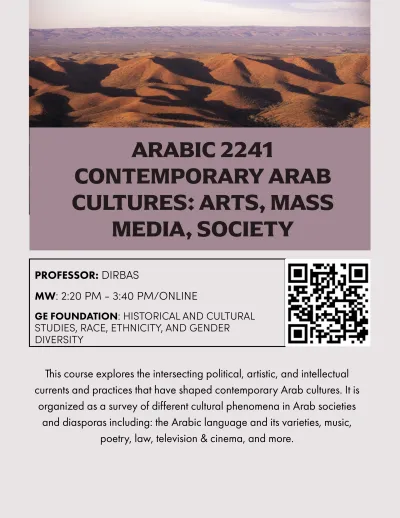
Arabic 2241 - Contemporary Arab Cultures: Arts, Mass Media, Society
Explores the intersecting political, artistic, and intellectual currents and practices that have shaped contemporary Arab cultures. Organized as a survey of different cultural phenomena in Arab societies and diasporas including: the Arabic language and its varieties, music, poetry, law, television & cinema, and more. We will critically examine various meanings of the term “culture,” such as social norms, popular culture, and the arts. Contains engagement with literary narrative, poetry, film, music, theater, and architecture from Arab regions. Students play an active role in curating course content. Taught in English.
Professor: Hekmat Dirbas
GE Foundation: Historical and Cultural Studies, GE Foundation: Race, Ethnicity, and Gender Diversity
Credit Hours: 3
Online, MW: 2:20 PM - 3:40 PM
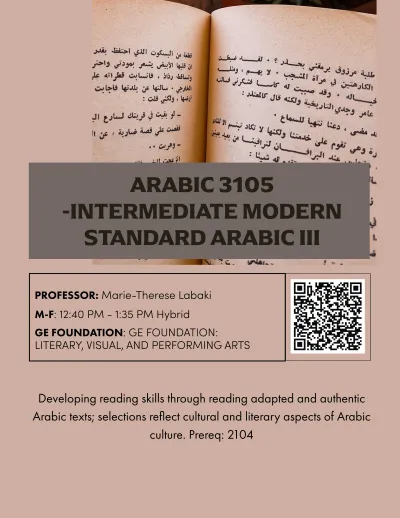
Arabic 3105 - Intermediate Modern Standard Arabic III
Developing reading skills through reading adapted and authentic Arabic texts; selections reflect cultural and literary aspects of Arabic culture.
Prereq: 2104
Professor: Marie-Therese Labaki
Credit Hours: 5
M-F: 12:40 PM - 1:35 PM
Arabic 3702 - Place, Space, and Migration in Modern Arabic Literature and Film
This course on modern Arabic literature and culture in translation focuses on questions of belonging, relationship to space, and migration. It examines how Arabic literary narratives, films, documentaries, and other arts have imagined modes of belonging to spaces such as cities and nations, the natural world (and even the universe!) from the early postcolonial period to the present. GE Theme: Lived Environments
Prereq: English 1110 or GE foundation writing or literacy course
Professor: Johanna Sellman
Credit Hours: 3
TR: 12:45 PM - 2:05 PM
Arabic 3705 - A Thousand and One Nights: Storytelling in Arabic and World Literature
We will examine the 1001 Nights as a text that reflects or challenges stereotypes of race, gender, and ethnicity. In this course, students will read the original stories, analyzing assumptions about race, gender, and ethnicity, and also come to understand the process by which the corpus of Nights was preserved, expanded, translated, disseminated, and even forged. This course is taught in English. GE Foundation: Literary, Visual, and Performing Arts
Professor: Shurouq Ibrahim
Credit Hours: 3
MW: 9:35 AM - 10:55 AM
Arabic 5651 - Contemporary Arabic Prose Fiction
Reading and analysis of short stories and novels representative of major developments and trends of the 20th century.
Prereq: Arabic 3105 or permission of instructor
Professor: Johanna Sellman
Credit Hours: 3
TR: 3:55 PM - 5:15 PM
Arabic 7602 - Studies in Arabic Prose
Advanced study of specific periods, authors and/or genres of prose writing (literary or non-literary) involving extensive reading and discussion of primary and secondary materials.
Prereq: 6 cr hrs of Arabic Literature at the 5000 level or equiv.
Professor: Johanna Sellman
Credit Hours: 3
TR: 3:55 PM - 5:15 PM
Hebrew/Jewish Studies
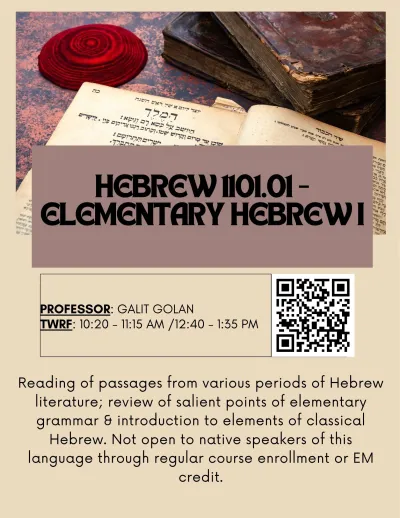
Conversation, reading, writing, vocabulary building, phonetics, and grammar of Hebrew.
Prereq: Closed to native speakers of this language. Not open to students with 3 or more years of high school Hebrew through regular course enrollment or EM credit. This course is available for EM credit. GE for lang course.
Professor: Galit Golan
GE Foundation: World Languages
Credit Hours: 4
TWRF: 10:20 AM - 11:15: 12:40 - 1:35 PM
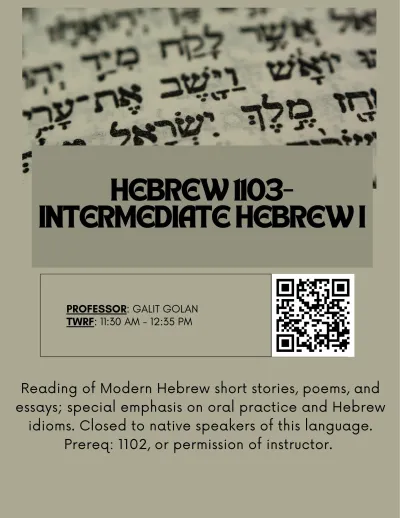
HEBREW 1103.01: Intermediate Hebrew I
Reading of Modern Hebrew short stories, poems, and essays; special emphasis on oral practice and Hebrew idioms.
Prereq: Closed to native speakers of this language. 1102, or permission of the instructor. This course is available for EM credit. GE for lang course.
Professor: Galit Golan
GE Foundation: World Languages
Credit Hours: 4
TWRF: 11:30 AM - 12:35 PM
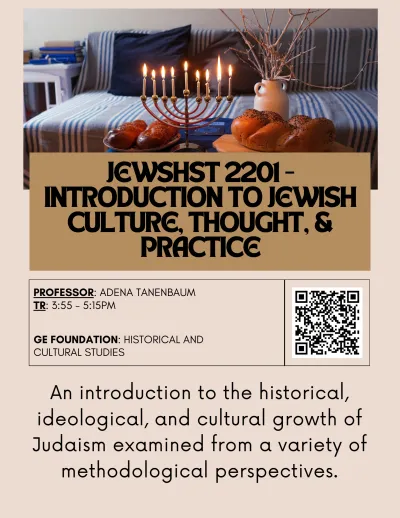
An introduction to the historical, ideological, and cultural growth of Judaism examined from a variety of methodological perspectives.
Prereq: Not open to students with credit for 201.
Professor: Adena Tanenbaum
GE Foundation: Historical and Cultural Studies
Credit Hours: 3
TR: 3:55 - 5:15 PM
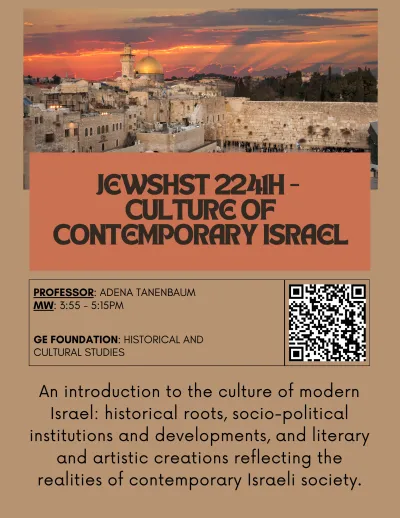
HEBREW 2241: Culture of Contemporary Israel
An introduction to the culture of modern Israel: historical roots, socio-political institutions and developments, and literary and artistic creations reflecting the realities of contemporary Israeli society. The purpose of this course is to familiarize students with contemporary Israeli culture in all of its diversity. Since the founding of the State in 1948, Israeli society has faced a series of dramatic challenges and has undergone tremendous changes. This course will survey the major social, cultural, religious and political trends in Israel, with special emphasis on the post-1967 period.
Prereq: 2241H requires Honors standing, or permission of instructor. Cross-listed in Jewish Studies 2242.
Professor: Adena Tanenbaum
GE Foundation: Historical and Cultural Studies
Credit Hours: 3
MW: 3:55 - 5:15 PM
JEWSHST/History 2453: History of Zionism and Modern Israel
A history of the Jewish state from the rise of Zionism to the present, with a focus on migration and displacement. Topics include: Jewish-Arab relations, the encounter between European and Middle Eastern Jews, the creation of a new Hebrew identity, the impact of the Holocaust, ethnic conflict and social protest, war and diplomacy, religion and the state and struggles over the nature of the regime. Cross-listed in History.
Professor: Ori Yehudai
GE theme: migration, mobility, and immobility course
Credit Hours: 3
Tues/Thurs: 9:35 AM - 10:55 AM
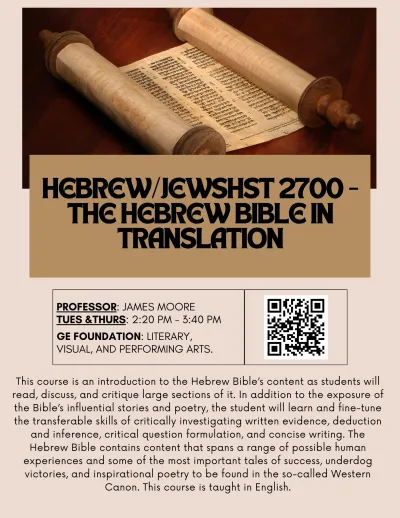
Hebrew/JEWSHST 2700: Introduction to the Hebrew Bible/Old Testament
Reading and analysis of selected chapters from the Hebrew scriptures and post-biblical Hebrew writings representative of major historical, cultural, and literary trends.
Prereq: English 1110.
Professor: James Moore
GE Foundation: Literary, Visual, and Performing Arts, GE Foundation: Race, Ethnicity & Gender Diversity
Credit Hours: 3
TR: 2:20 PM - 3:40 PM
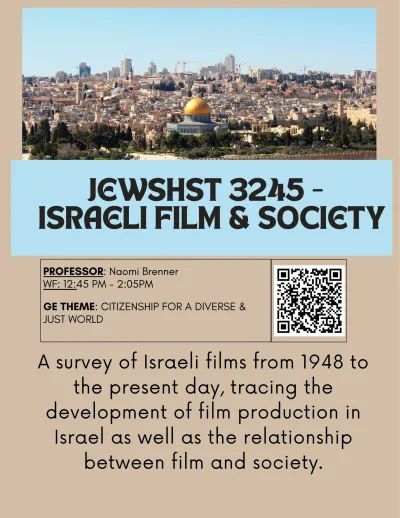
Hebrew/JEWSHST 3245: Israeli Film & Society
A survey of Israeli films from 1948 to the present day, tracing the development of film production in Israel as well as the relationship between film and society.
Prereq: English 1110.
Professor: Naomi Brenner
GE Foundation: Citizenship for a Diverse and Just World
Credit Hours: 3
Wed/Fri: 12:45 PM - 2:05 PM
The course will enable students to reflect on the ways in which the past informs interpretations of the present and the ways in which the present informs interpretations of the past. The course will adopt a broad definition of the "present", investigating the Israeli-Palestinian conflict primarily against the background of the collapse of the Oslo peace process in the early 2000s. This course is cross-listed with History.
Prereq or concur: English 1110.xx, or GE foundation writing and info literacy course, or permission of instructor.
Professor: Ori Yehudai
GE Theme: Citizenship for a diverse and just world course
Credit Hours: 3
Tues/Thurs: 12:45 PM - 2:05 PM
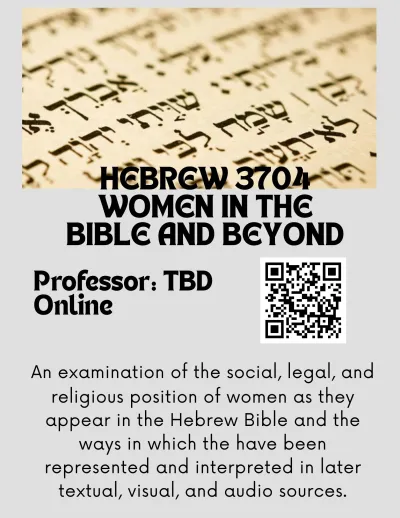
This course examines the cultural images and legal status of women during biblical times and late antiquity. Although its focus will be on the period of ancient Israel, students will also examine how biblical narrative and law have continued to have an impact on Jewish, Christian and secular culture. By looking at the images of women in biblical texts, students will be asked how contemporary feminist readers of the Bible have found new meanings in a literature that has been the subject of so much re-reading and re-writing over the centuries. The course will begin with a general review of biblical literature and a historical survey of the status of women in some ancient societies. Throughout, its approach will be interdisciplinary, inviting students to pursue interests in historical, literary critical, feminist, and religious studies approaches.
Prereq: English 1110
Professor: TBD
GEN Foundation: Race, Ethnicity & Gender Diversity
Credit Hours: 3
Online/Asynchronous
Introduction of main elements of Biblical Hebrew grammar and syntax, for study of ancient and late antique Mediterranean religion and History, for students in Classics, History, NELC, etc. Requires no previous study of Hebrew language but assumes moderate experience with studying another/non-native language.
Prereq: Third-semester level [1103] in any other modern or classical language, or permission of instructor.
Professor: Daniel Frank
Credit Hours: 3
Wed/Fri: 9:35 AM - 10:55 AM
Hindi
Hindi 1101.01 - Elementary Hindi I
Study of Hindi language, with appropriate cultural background; development of listening, reading, speaking, and writing. Hindi, belonging to the Indo-European family of languages, is one of the 15 officially recognized languages of India. The goals of Hindi 1101 are to introduce students to the Devanagari script and sound system, elementary vocabulary, basic grammar and sentence structure, as well as to enable students to identify the elements of the spoken and the written language. Students will also learn about the culture, traditions, and history of India. By the completion of this course, students are expected to have enough vocabulary to participate in a basic conversation, and to be able to read and write simple sentences.
Prereq: Closed to native speakers of the language. This course is available for EM credit.
Professor: Preeti Palvankar
GE Foundation: World Languages
Credit Hours: 4
MTWR: 4:10- 5:05 PM
Hindi 1103.01 - Intermediate Hindi I
Continued study of Hindi language, with appropriate cultural background; development of listening, reading, speaking, and writing. In Hindi 1102 and 1103, students are further trained to develop their skills of speaking, comprehension, reading and writing. A variety of practice activities and language tasks, ranging from mechanical to communicative, will be used in class, such as grammar exercises, pronunciation practice, language games, reading and listening comprehensions, movie watching, songs, role-playing, and small skits and plays. Presentations and discussions about Indian culture will be required and encouraged. After completing these three courses, students should be able to listen to complex conversations or stories, watch movies and understand them, read and understand short texts, engage in conversations on everyday topics, and write essays on familiar topics using the structures and vocabulary introduced in class. The course should add to students' familiarity and understanding of Indian culture.
Prereq: 1102. This course is available for EM credit.
Professor: Preeti Palvankar
GE Foundation: World Languages
Credit Hours: 4
MTWR: 5:20- 6:15 PM
Hindi 2104 - Intermediate Hindi II
Continued study of the Hindi language, with appropriate cultural background; development of listening, reading, speaking, and writing.
This course will be set up as an independent study, NELC 5193. Course details, including the meeting pattern and instructor information, will be provided soon.
Prereq: 1103. This course is available for EM credit.
Professor: TBD
Credit Hours: 3
Meeting details: TBD
Islam
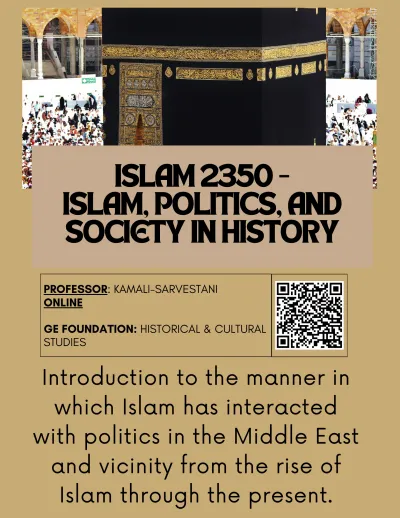
Islam 2350 - Islam, Politics, and Society in History
Introduction to the manner in which Islam has interacted with politics in the Middle East and vicinity from the rise of Islam through the present.
Prereq: English 1110.xx.
Professor: Mehrak Kamali-Sarvestani
GE Foundation: Historical & Cultural Studies
Credit Hours: 3
Online
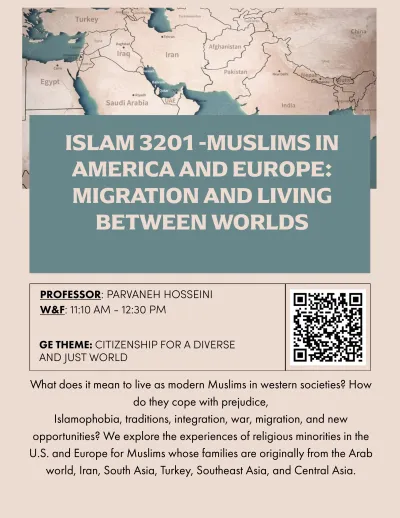
What does it mean to live as modern Muslims in western societies? How do they cope with prejudice, Islamophobia, traditions, integration, war, migration, and new opportunities? We explore the experiences of religious minorities in the U.S. and Europe for Muslims whose families are originally from the Arab world, Iran, South Asia, Turkey, Southeast Asia, and Central Asia.
Professor: Parvaneh Hosseini
GE Theme: Citizenship for a Diverse and Just World
Credit Hours: 3
W&F: 11:10 AM - 12:30 PM
Utilizing new historical methods for reading and interpreting the sparse contemporary and near-contemporary testimonies for this historical period, this course explores how these testimonies, both Muslim and non-Muslim, continue to challenge historians to revise the history of the Islamic conquests. In this course a strong focus is placed on reading primary source materials in translation.
Professor: Sean Anthony
GE Themes: Historical study and diversity global studies course, and historical and cultural studies course
Credit Hours: 3
Tues/Thurs: 9:35 AM - 10:55 AM
Islam 3501 - Introduction to Islam
Examination of Islam as a world religion, enabling an understanding of its major tenets and beliefs as they are envisioned by insiders and outsiders.
Prereq: English 1110. Not open to students with credit for NELC 3501.
Instructor: Sean Anthony
GE Theme: Traditions, Cultures, and Transformations
Credit Hours: 3
Tues/Thurs: 11:10 AM - 12:30 PM
NELC
NELC 2200 - Introduction to the Modern Middle East
This course will read and analyze a variety of short stories to illuminate different cultures of the Middle East and South Asia. The goal of the course is to introduce students to diverse cultures through literature. Students will be become familiar with a variety of literary representations, social structures and religious, ethnic and racial diversity after the completion of this course. Cross-listed in IntStds.
Professor: Hosseini Parvaneh
GE Foundation: Race, Ethnicity & Gender Diversity
Credit Hours: 3
Weds/Fri: 2:20 PM - 3:40 PM
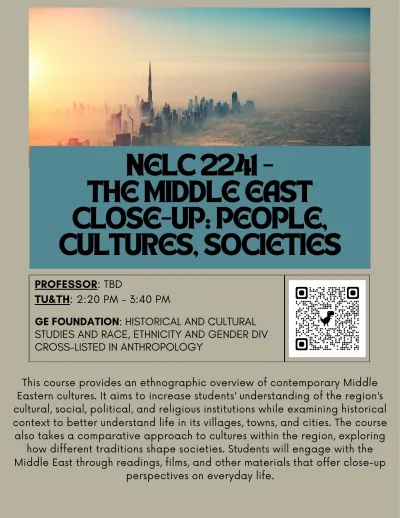
NELC 2241 - The Middle East Close-Up: People, Cultures, Societies
Introduction to the culture of the Middle East as lived in its villages, towns, and cities.
Professor: TBD
GE Foundation: Race, Ethnicity, and Gender Diversity and Historical and Cultural Studies.
Credit Hours: 3
Tues/Thurs: 2:20 PM - 3:40 PM (Hybrid)
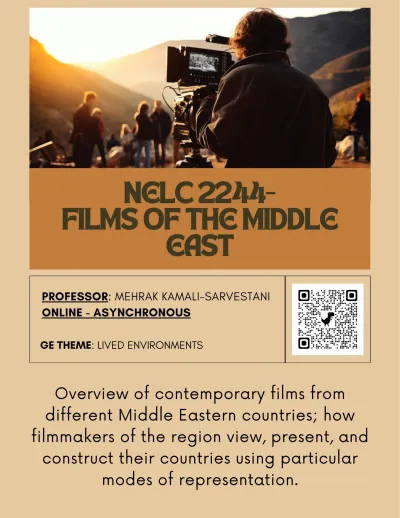
NELC 2244 - Films of the Middle East
Overview of contemporary films from different Middle Eastern countries; how filmmakers of the region view, present, and construct their countries using particular modes of representation.
Professor: Mehrak Kamali-Sarvestani
Prereq: English 1110.
GE Theme: Lived Environments
Credit Hours: 3
Online
This course examines histories, lived experiences, and artistic representations of citizenship and diaspora. Over the course of the semester, we will focus on South Asia, specifically India/Pakistan, and the Middle East, specifically Israel/Palestine, two societies in which citizenship and diaspora have been particularly significant and complex, as well as diasporic communities in the US.
Professors: Naomi Brenner, Ila Nagar
GE Theme: Citizenship for a Diverse and Just World
Credit Hours: 3
Weds/Fri: 9:05 AM - 10:55 AM
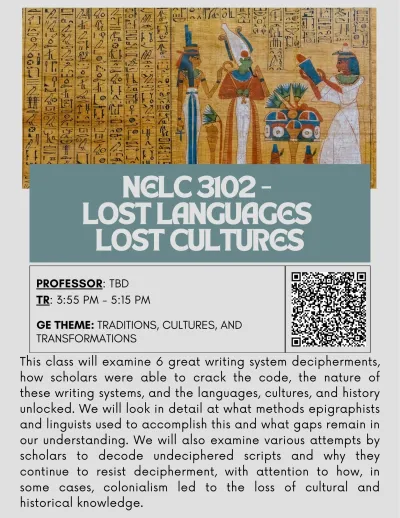
NELC 3102 - Lost Languages Lost Cultures
The last known Hieroglyphic text is a graffito dated to 394 CE. Knowledge of this ancient writing system disappeared once all non-Christian temples in Egypt were closed by the Romans, and with it, 3000 years of Egypt’s history. Myths surrounding the meaning of these mysterious writings emerged. Medieval scholars read allegorical meanings into the elaborate epigraphs, always assuming that the hieroglyphs recorded ‘ideas’, but were never able to divine their meaning. For nearly 15 centuries, the writing system resisted decipherment. In 1822, the French scholar F. Champollion unlocked the script and with it a lost language – Ancient Egyptian. The next decades saw nearly the millennia of lost history restored. But how was this accomplished? The decipherment of Egyptian hieroglyphs is but one story in the decipherment of forgotten writing systems and lost languages in the 19th and 20th centuries. This class will examine 6 great decipherments, how scholars were able to crack the code, the nature of these writing systems, and the languages, cultures, and history unlocked. We will look in detail at what methods epigraphists and linguists used to accomplish this and what gaps remain in our understanding. The second part of the course will turn to undeciphered scripts. We will examine various attempts by scholars to decode this group of writing systems and why they continue to resist decipherment, with due attention to how, in some cases, colonialism led to the loss of cultural and historical knowledge.
Professor: TBD
GE Theme: Traditions, Cultures, and Transformations
Credit Hours: 3
Tues/Thurs: 3:55 PM - 5:15 PM
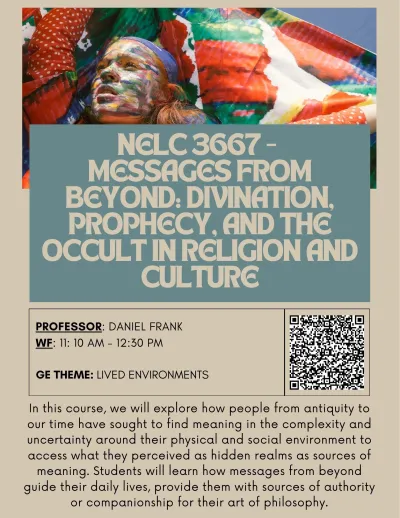
NELC 3667 - Messages from Beyond: Divination, Prophecy, and the Occult in Religion and Culture
In this course, we will explore how people from antiquity to our time have sought to find meaning in the complexity and uncertainty around their physical and social environment to access what they perceived as hidden realms as sources of meaning. Students will learn how messages from beyond guide their daily lives, provide them with sources of authority or companionship for their art of philosophy.
Professor: Daniel Frank
GE Theme: Lived Environments
Credit Hours: 3
Weds/Fri: 11: 10 AM - 12:30 PM
NELC 3689: Words Across World
Language, at the heart of our social life, drives much of what humans do: converse, convey beliefs & views, label, categorize, include & exclude people. We'll critically examine how we use language to interact with our lived environments (LE) & analyze & discover ways in which words are used & manipulated to impact our LE & how changes & developments in our LE can have a direct effect on language. Cross-listed in German and Spanish.
Professors: Naomi Brenner & Ila Nagar
GE Theme: Lived Environments
Credit Hours: 3
Tues/Thurs: 9:35 AM - 10:55 AM
NELC 3700: Mythology of Ancient Egypt and Mesopotamia
An introductory comparative survey of the mythology of ancient Egypt and Mesopotamia.
Professor: Sarah Schellinger
Prereq: English 1110, or GE foundation writing and info literacy course
GE Theme: Lived Environments
Credit Hours: 3
Tues/Thurs: 2:20 PM - 10:55 AM
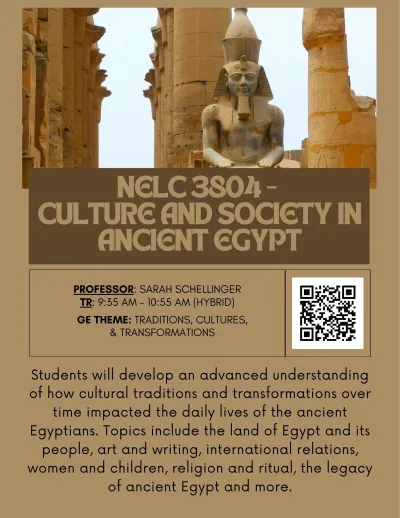
NELC 3804: Culture and Society in Ancient Egypt
Students will develop an advanced understanding of how cultural traditions and transformations over time impacted the daily lives of the ancient Egyptians. Topics include the land of Egypt and its people, art and writing, international relations, women and children, religion and ritual, the legacy of ancient Egypt and more
Professor: Sarah Schellinger
GE theme: Traditions, Cultures, and Transformations course & High-Impact Practice Research and Creative Inquiry.
Credit Hours: 4
Tues/Thurs: 9:35 AM - 10:55 AM
NELC 5145: Digital Editions of Ancient Texts and Artifacts
This training course is designed to introduce students to the purpose, philosophy, use, and construction of digital editions of ancient sources or artifactual databases. Students will be taught how to construct a basic PostgreSQL database using both command line input (cli) and administrative graphic user interfaces (GUIs).
Prereq: At least one year of an ancient Semitic or Indo-European language taught at the university level.
Professor: James Moore
Credit Hours: 3
Weds: 2:15 PM - 5:00 PM
Persian
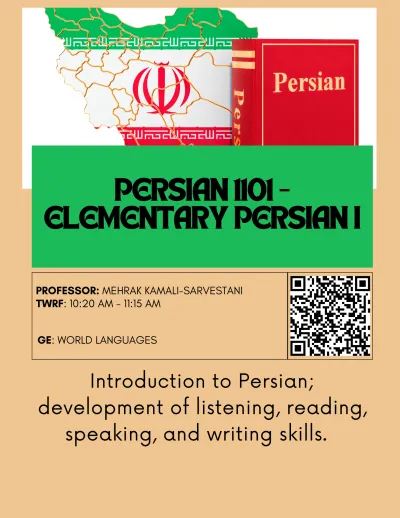
PERSIAN 1101 - Elementary Persian I
Introduction to Persian; development of listening, reading, speaking, and writing skills. In Persian 1101, Elementary Persian I, students learn the alphabet, some basic conversational Persian, one third of the grammar content of the required text, and about 500 words in addition to basic grammatical items. They also read and write simple prose of approximately one paragraph in length. The final grade is determined on the basis of class attendance, homework, quizzes, a midterm test, and a final examination.
Professor: Mehrak Kamali-Sarvestani
GE: World Languages
Credit Hours: 4
TWRF: 10:20 AM - 11:15 AM
PERSIAN 1103 - Intermediate Persian I
Further development of listening, writing, speaking, and reading skills; reading of simplified Persian texts. Students begin consolidating skills in conversational and social Farsi, master the last third of the required text of 1101 and 1102, acquire an active vocabulary of 2,200 words, begin to read shorter, annotated literary texts, and write simple expository prose of about a page in length. The required text and dictionaries are the same as in 1110 and 1102. The final grade is determined on the basis of class attendance, homework, quizzes, a midterm test, and a final examination. In Persian 2104, Intermediate Persian II, students master conversational and social Farsi and read and write in Farsi about general or non-specialized subjects without frequent reference to bilingual dictionaries or grammars.
Prereq: 1102 or permission of instructor.
Professor: Mehrak Kamali-Sarvestani
GE: World Languages
Credit Hours: 4
TWRF: 11:30 AM - 12:25 PM
South Asia
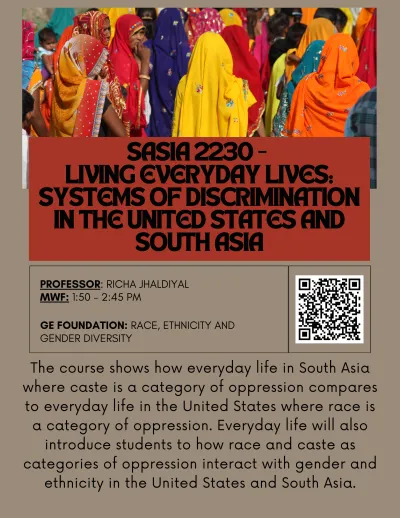
The course shows how everyday life in South Asia where caste is a category of oppression compares to everyday life in the United States where race is a category of oppression. Everyday life will also introduce students to how race and caste as categories of oppression interact with gender and ethnicity in the United States and South Asia.
Professor: Richa Jhaldiyal
GE Foundation: Race, Ethnicity and Gender Diversity
Credit Hours: 3
MWF: 1:50 PM - 2:45 PM
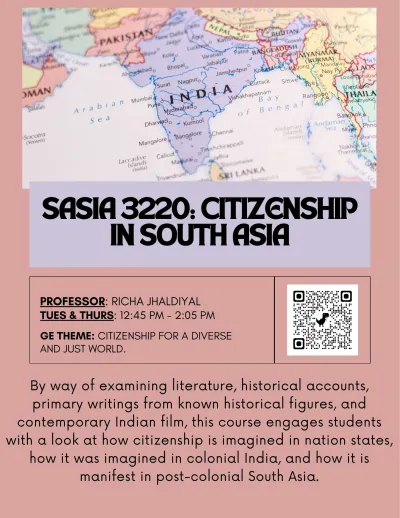
SASIA 3220 - Citizenship in South Asia
This course engages students with a look at how citizenship is imagined in nation states, how it was imagined in colonial India, and how it is manifest in post-colonial South Asia.
Professor: Richa Jhaldiyal
GE Theme: Citizenship for a Diverse and Just World
Credit Hours: 3
Tues/Thurs: 12:45 - 2:05 PM
SASIA 3625 - Understanding Bollywood, Knowing India: Hindi Cinema Since 1960
Explores life in India from the lens of Hindi language cinema. Course engages with social class, gender, sexuality, Indian diaspora in the West, family structure, marriage, politics, caste, language (special focus on multilingualism in India), religion, and globalization, and how these relate to lived experiences of people in Indian society. Not for Film Studies credit.
Professor: Ila Nagar
GE Theme: Citizenship for a Diverse and Just World
Credit Hours: 3
Online OR In-person MWF: 3:00 PM - 3:55 PM
SASIA 3635: Desi Diaspora: South Asians in the United States
This course is designed as a multi-disciplinary introduction to communities with South Asian heritage who live in the United States of America. The material for the class centers on the South Asian diaspora in the US. The class aims to teach students the connections between diasporas, identities, nationalism, citizenship, and if diasporic communities have lived experiences that are unique.
Professor: Richa Jhaldiyal
GE Theme: Citizenship for a Diverse and Just World
Credit Hours: 3
MWF: 11:30 AM - 12:25 PM
Turkish
TURKISH 1101: Elementary Turkish I
Introduction to Turkish; development of listening, reading, speaking, and writing skills. Typically offered Autumn semester. In Turkish 1101, students learn the alphabet, basic conversational Turkish, and half the grammar content of the required text. They master at least 500 words in addition to basic grammatical items, and read and write simple prose of approximately one paragraph in length. Students will also be required to purchase the materials of the accompanying oral course at nominal cost. The final grade is determined on the basis of class attendance, homework, quizzes, one midterm test, and one final examination.
Professor: TBD
GE Foundation: World Languages
Credit Hours: 4
TWRF: 1:50 PM - 2:45 PM (Hybrid)
TURKISH 1103: Intermediate Turkish I
Reading of Turkish short stories and poems with attention to literary and cultural appreciation; development of basic language skills. In Turkish 1103, students master conversation and social Turkish and read and write Turkish on general or non-specialized subjects without frequent recourse to bilingual dictionaries or grammars. With an active vocabulary of 1,500-5,000 words students are able to write two- or three-page summaries, presentations, and reports without extraordinary effort. The required texts and dictionaries are the same as for 1102 and the final grade determination is on the basis of class attendance, homework, quizzes, a midterm test, and a final examination.
Prereq: 1102, or placement exam.
Professor: TBD
GE Foundation: World Languages
Credit Hours: 4
TWRF: 10:20 AM - 11:15 AM
Turkish 3797 - Global Intercultural Citizenship in the Middle East: Turkey
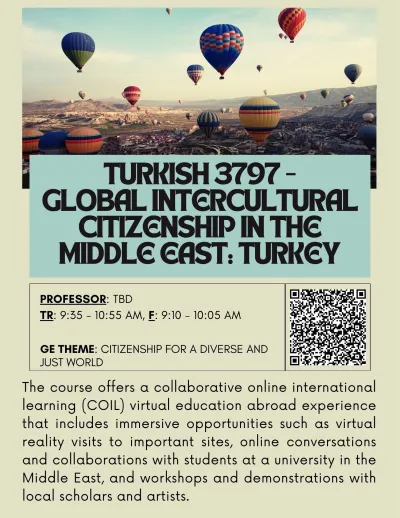
The course offers a collaborative online international learning (COIL) virtual education abroad experience that includes immersive opportunities such as virtual reality visits to important sites, online conversations and collaborations with students at a university in the Middle East, and workshops and demonstrations with local scholars and artists.
Professor: TBD
GE Theme: Citizenship for a Diverse & Just World
Credit Hours: 4
TU&TH: 9:35 - 10:55 AM; Friday 9:10 AM -10:05 AM (Online)
Urdu
Urdu 1101: Elementary Urdu I
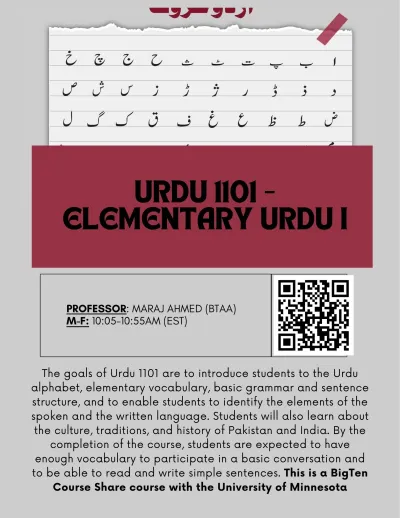
The goals of Urdu 1101 are to introduce students to the Urdu alphabet, elementary vocabulary, basic grammar and sentence structure, and to enable students to identify the elements of the spoken and the written language. Students will also learn about the culture, traditions, and history of Pakistan and India. By the completion of the course, students are expected to have enough vocabulary to participate in a basic conversation, and to be able to read and write simple sentences.
Professor: Meraj Ahmed (BTAA University of Minnesota)
GE Foundation: World Languages
Credit Hours: 4
Online M-F: 10:05 AM - 10:55 AM (EST)
Urdu 1103: Intermediate Urdu I
Continued study of Urdu language, with appropriate cultural background; development of listening, reading, speaking, and writing skills.
Prereq: 1102, or permission of instructor.
Professor: Meraj Ahmed (BTAA University of Minnesota)
GE Foundation: World Languages
Credit Hours: 4
Online M-F: 11:10 AM - 12:00 PM (EST)
Uzbek
Uzbek 1103: Elementary Uzbek 1
Introduction to the Uzbek language; development of listening, reading, speaking, and writing skills. This course will increase students' knowledge of the sound system, alphabet, and the basic structure and practical use of the Uzbek language. Throughout the course, practice of all four language skills, listening comprehension, speaking, reading, and writing, will be stressed extensively.
Prereq: Not available to native speakers. This course is available for EM credit.
Professor: TBD
GE Foundation: World Languages
Credit Hours: 4
Online - Details to Come Soon
Uzbek 2102: Intermediate Uzbek II
This intermediate-level course aims to increase students' fluency in oral expression, develop their listening and reading skills, and extend their understanding of the fundamentals of the grammar and literary language of Uzbekistan. The 4-skill comprehensive approach will be used in the course, and a communicative approach will be taken, which opens a wider perspective on language learning. During the course, students will learn grammar and vocabulary.
Prereq: 2101, or placement exam.
Professor: TBD
Credit Hours: 3
Online - Details to Come Soon